
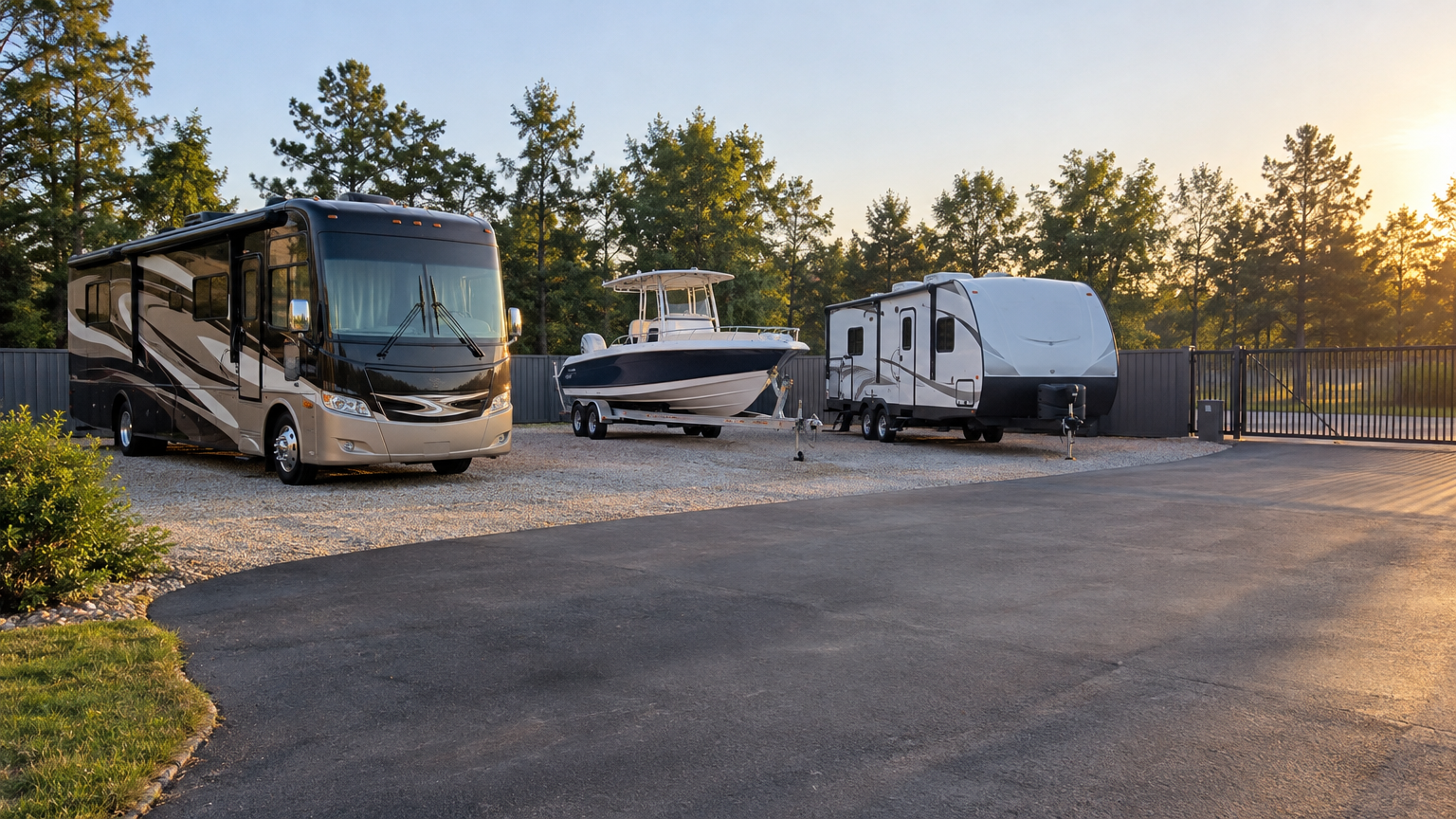
What does RV, boat, lot, and multi-space hosting include?
RV, boat, lot, and multi-space hosting covers storage areas for motorhomes, travel trailers, fifth wheels, boats, equipment, and other large items. It may involve one clearly marked space or several positions on the same property. Storage is different from active use, repairs, overnight stays, loading, or occupancy, so those details need to be stated.
A host might offer an outdoor lot, a section of a backyard, an indoor building, a covered area, or a paved space behind a gate. A renter might need a place for a boat and trailer between trips, a private RV storage lot during the off-season, or trailer storage space that is easier to reach than a commercial facility.
The word “storage” shouldn't be treated as a blanket permission for every activity. A listing may allow drop-off and pickup but prohibit washing, mechanical work, hookups, sleeping, or unloading personal belongings. If a property has several spaces, each position may have different dimensions and access conditions.
Hosts can browse available lots to see how this type of space is categorized on Parking Mate. Renters should focus less on the label and more on whether the actual space fits the item, route, schedule, and intended use.
What should be measured before an RV, boat, or trailer is booked?
A suitable storage space must work for the full vehicle or trailer, not just the section where it will rest. Measure the item, tow setup, entry route, gate, overhead obstacles, and maneuvering area together. RV Industry Association dimensions are useful planning references, but they aren't universal sizes or local legal standards.
- Usable length: Measure the space from the stopping point to the nearest obstacle. Include room for a tongue, hitch, ladder, spare tire, rear rack, slide-outs if relevant, or other equipment that extends beyond the main body.
- Total width: Check the widest part of the RV, boat, trailer, or attached equipment. Account for mirrors, awnings, wheel wells, and space needed to open doors without entering another assigned position.
- Total height: Include roof equipment such as air conditioners, satellite equipment, storage boxes, and antennas. Measure the lowest overhead point along the entire route, not only the doorway or final parking area.
- Combined vehicle-and-trailer length: A boat on a trailer or a travel trailer pulled by a truck may need room for both pieces during arrival and departure. Confirm whether the tow vehicle stays on the property or leaves after the item is positioned.
- Route and gate clearance: Check the gate opening, driveway width, curb cut, fences, trees, posts, utility equipment, and overhead branches. A space can look large enough while the entrance prevents the vehicle from reaching it.
- Turning or backing room: Large trailers often need to straighten, back, or make more than one adjustment. BoatUS advises checking the vehicle, trailer, curbs, and surrounding obstacles instead of judging only the final parking rectangle.
A host should record measurements in a consistent way and identify whether each one is an estimate or a confirmed usable dimension. Renters should send the complete dimensions of their equipment before booking, including the tow vehicle when it will enter the property.
Boat and trailer access deserves extra attention. BoatUS also recommends checking the route to the nearest boat ramp and the conditions a driver will face while towing. A lot that works for seasonal storage may not be convenient for frequent launch trips.
What should a host disclose for each storage space?
A useful listing tells renters what they can expect before arrival. For each position, describe the exact dimensions, route, surface, visible security features, and allowed activities. If a property has several spaces, use separate labels and photos so a renter doesn't assume that every position has the same access or capacity.
Five disclosure areas deserve special attention:
- Space identity and dimensions: Label spaces as A, B, C, or with another clear system. State usable length, width, height, and whether the measurement includes room for a tow vehicle or attached trailer.
- Arrival and departure access: Explain the entrance, gate, access hours, route from the street, backing expectations, and whether the renter must contact you before arrival. Mention tight turns or areas that cannot be blocked.
- Surface and drainage: Identify concrete, asphalt, gravel, grass, soil, or another surface. Note slopes, soft areas, standing water, drainage patterns, and whether jacks, stabilizers, blocks, or wheel equipment are allowed.
- Observable security features: Describe a fence, gate, lighting, lock, camera, or host access procedure only if it exists and is maintained. These details set expectations, but they aren't guarantees against theft or damage.
- Permitted uses: State whether the booking covers storage only or also allows loading, unloading, washing, repairs, hookups, or temporary access to the item. Address sleeping and occupancy directly rather than leaving renters to guess.
Photos should show the approach, gate, assigned space, overhead clearance, nearby obstacles, and the surface. A close-up image of an empty parking rectangle doesn't tell a boat owner whether the trailer can turn into it.
With multi-space storage hosting, calendar management also matters. A larger RV may need a neighboring area during backing, while a smaller trailer may not. If one booking can affect another space, explain the arrangement before accepting it and keep the availability information current.
Hosts can list a storage space on Parking Mate with details, photos, pricing, and availability. The platform doesn't determine whether a particular property is suitable or legally approved, so the host remains responsible for accurate information and local checks.
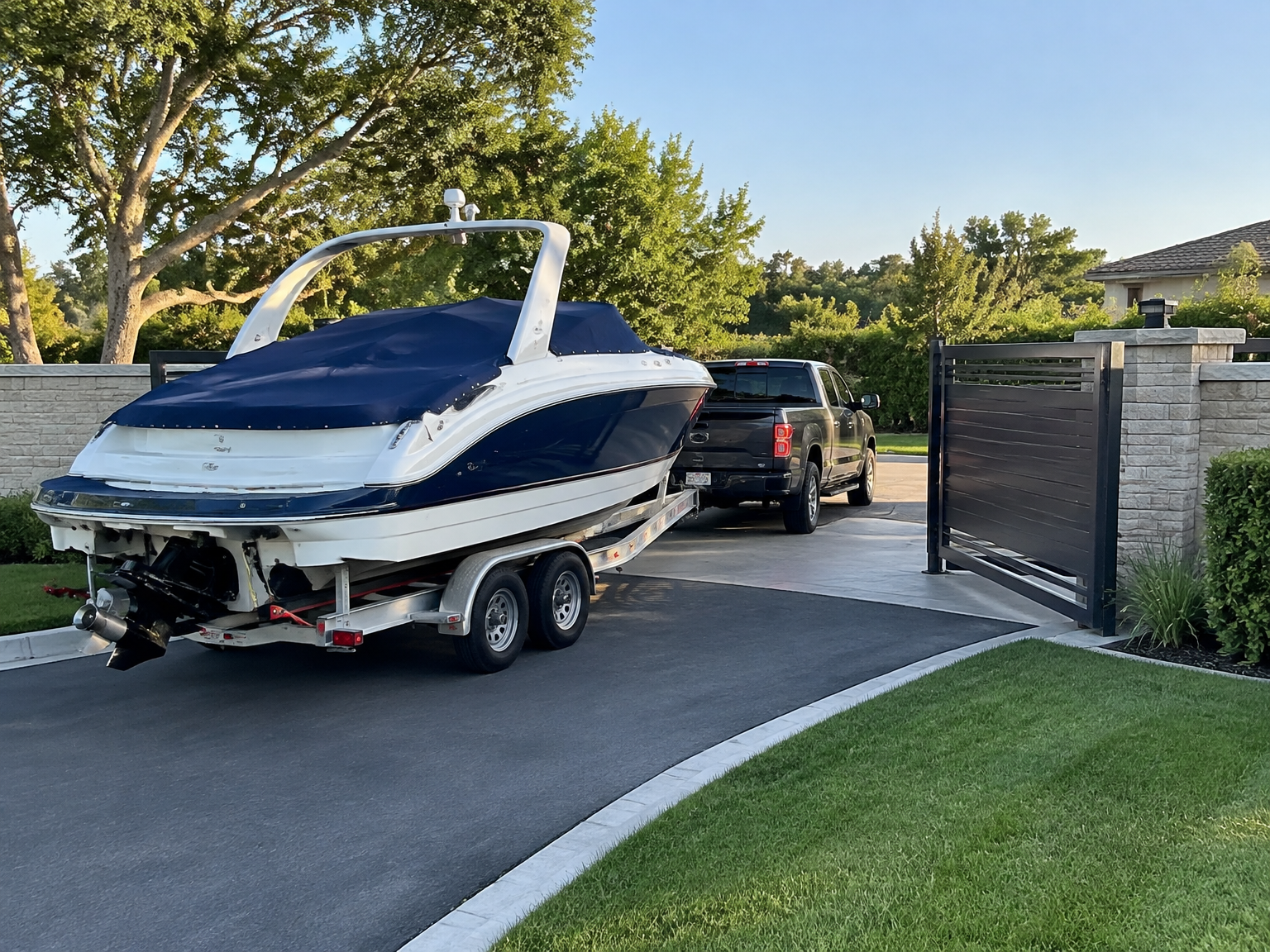
Which indoor, outdoor, paved, or unpaved setup fits the renter’s needs?
No single storage setup works best for every RV, boat, or trailer. Indoor storage reduces direct weather exposure but brings questions about door height, building clearance, ventilation, access hours, and floor conditions. Outdoor storage may be easier for large equipment, but the renter must examine drainage, surface stability, slope, and security expectations.
| Storage setup | Potential advantages | Details to confirm |
|---|---|---|
| Indoor storage | Protection from direct rain, snow, sun, and some outdoor exposure | Door width and height, interior clearance, ventilation, floor condition, access hours, and whether the full tow setup can enter |
| Covered outdoor storage | Some protection from sun and precipitation while keeping a more open route | Roof height, side clearance, drainage, turning room, surface, and whether the cover extends over the whole item |
| Paved outdoor lot | A firm, more predictable travel and parking surface | Surface cracks, slope, drainage, gate width, space between vehicles, and whether the pavement is suitable for the item |
| Gravel lot | May provide an open outdoor area with flexible parking positions | Tire support, ruts, soft spots, drainage, dust, backing conditions, and whether jacks or stabilizers are allowed |
| Grass or soil area | May be available where paved storage is not | Rain-related softness, rutting, levelness, drainage, tire support, and whether the item can be removed without damaging the ground |
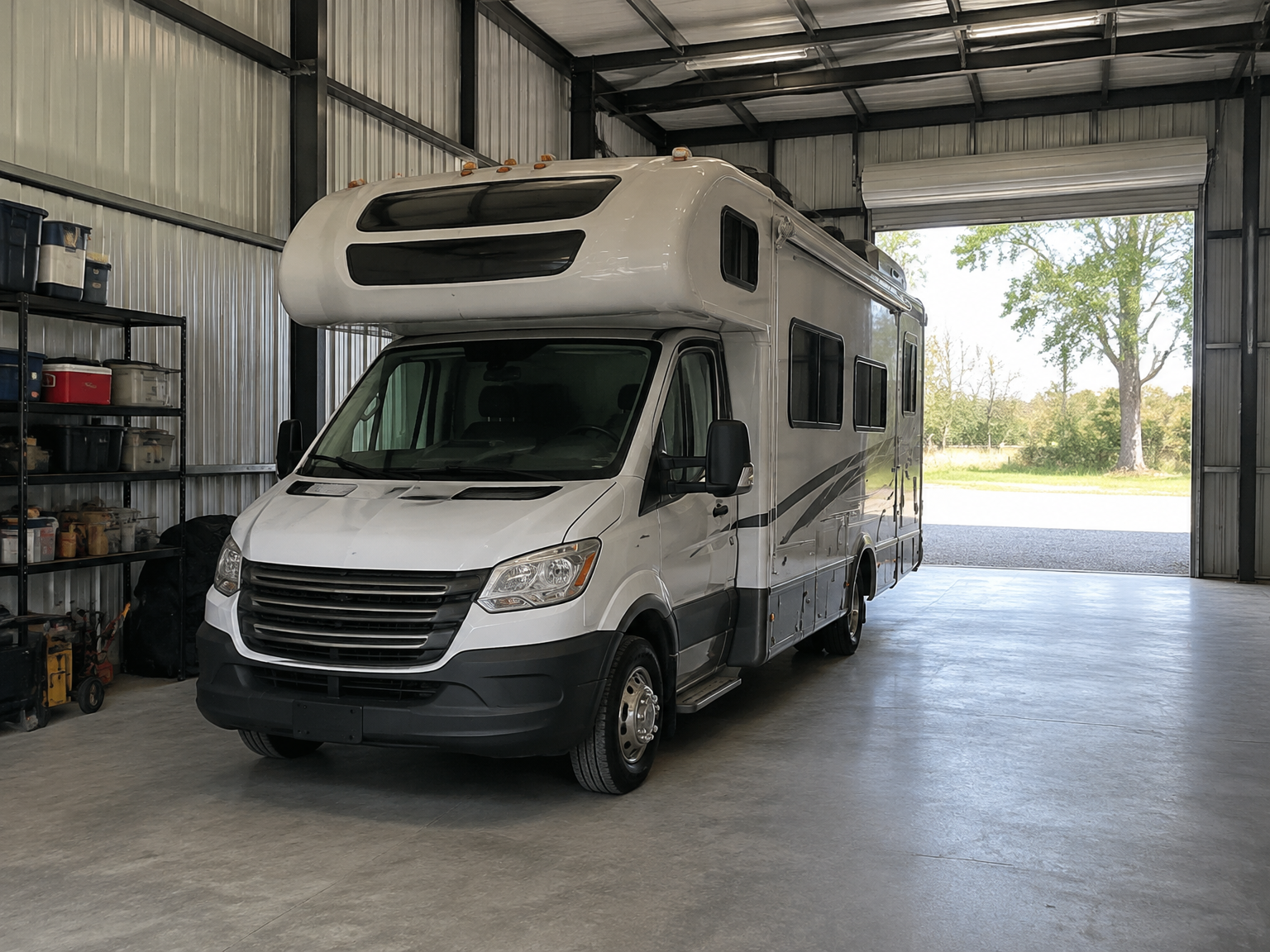
For indoor RV storage, measure the building entrance and the lowest interior obstruction. A motorhome with roof equipment may fit through the doorway but not under a beam inside. Boat and trailer storage may raise similar concerns about tongue length and turning space.
Outdoor boat storage also needs a practical exit plan. Ask whether the route stays usable after rain, whether the lot requires backing toward a street, and whether another stored item could block departure. The surface should be described honestly rather than presented as suitable for every trailer.
The renter's equipment and intended schedule should guide the choice. Someone retrieving a boat every weekend may value an easy route and broad turning area more than enclosure. Someone storing an RV for several months may focus on weather exposure, surface support, access rules, and security features.
Renters can search storage spaces and compare the details available in each listing. They should still ask questions when measurements, photos, or permitted uses are unclear.
How can renters confirm that a large item can enter, fit, and leave?
Renters should evaluate the complete trip through the property, from the public road to the assigned position and back out again. A usable parking rectangle is only one part of the fit. Gate width, curb cuts, overhead clearance, turning room, backing space, and other stored items may determine whether the booking works.
Use these checks before confirming:
- Compare complete dimensions: Match the listing’s usable measurements with the RV, boat, trailer, tow vehicle, hitch, roof equipment, and accessories. Ask whether the stated length is for the stored item alone or the full combination.
- Review the route from the street: Look at the entrance, gate, driveway, fence lines, trees, utility poles, slopes, and nearby parked vehicles. Request additional photos if the approach is difficult to judge.
- Ask about gates and tight turns: Confirm the gate’s usable opening, operating procedure, access hours, and whether the renter must back in. Ask who moves a gate or provides an access code.
- Confirm arrival, departure, and backing expectations: Find out whether the tow vehicle stays, whether the host must be present, whether another renter could block the route, and how pickup changes are handled.
A renter should share unusual dimensions and plans in writing before booking. For example, a fifth-wheel trailer may need a different approach than a travel trailer, and a boat with a long tongue may swing wider than expected during a turn.
BoatUS emphasizes that backing a boat trailer depends on the vehicle and trailer length, curbs, and obstacles. That guidance applies broadly to large trailer storage: the driver needs room to make corrections, not just a spot that looks long enough from above.
If a host cannot answer basic access questions, the renter should pause rather than assume the arrival will work. A confirmed booking does not change the physical dimensions of a gate or eliminate local restrictions.
What rules, security expectations, and permissions should be settled first?
Hosts and renters should agree on storage-only rules, access hours, washing, repairs, loading, unloading, hookups, sleeping, occupancy, and responsibility for damage before booking. Security features such as gates, lighting, locks, or cameras should be described accurately, but neither a private lot nor a marketplace booking guarantees protection.
The property’s legal and contractual rules need separate attention. A host should check city or county zoning, permits, HOA or condominium rules, lease terms, mortgage restrictions, and any limits on commercial or paid storage. Some locations allow personal RV or boat storage while restricting storage for compensation.
Local examples show why a universal rule would be misleading. Bellevue states that charging others for RV, watercraft, or trailer storage is not allowed in a residential land-use district. Other jurisdictions may address setbacks, paving, screening, registration, quantity, enclosure, or whether an RV can be used for sleeping. Those rules can differ even between nearby communities.
Insurance also needs a direct conversation. Parking Mate is not an insurer, and renters shouldn't assume that the host’s policy covers their RV, boat, trailer, belongings, or liability. The Insurance Information Institute explains that boat coverage varies by policy and may address the boat, motor, and trailer differently. Hosts should ask their insurer how paid storage and visitor access affect coverage.
Security descriptions should stay factual. “The lot has a locked gate and lighting” is different from “your boat is guaranteed safe.” Renters should consider their own locks and insurance if permitted by the host and policy. Hosts should keep access routes clear and avoid promising protection they cannot control.
Finally, clarify who may enter the property and when. Some bookings need occasional access for battery checks or maintenance, while others are strictly no-access storage. Written instructions about arrival, departure, contact procedures, and permitted work can prevent disputes long after the item has been parked.
How can Parking Mate support multi-space storage bookings?
Parking Mate connects hosts with renters looking for lots, storage, indoor areas, and outdoor spaces. Hosts set their own hourly or monthly prices, control availability, and add listing details and photos. Renters review the information, book dates, pay through Stripe, and follow the host’s arrival instructions.
For a host with several positions, the practical value is organization. Each space can be described according to its dimensions, surface, access route, and allowed use. A host might identify one position for a compact trailer, another for a motorhome, and a third for a boat and trailer, provided the property rules and physical conditions support those uses.
Availability should reflect real access conditions. If a large renter needs an adjacent area to maneuver, that area may not be available to another renter at the same time. Hosts should account for those limits in the calendar and explain them in the listing.
Renters should read the listing carefully and ask questions about anything that affects arrival. Parking Mate provides the booking marketplace and payment workflow, but it doesn't inspect every property for fit, zoning, insurance, or security. The host and renter still need to confirm the practical details.
Listing is free, with no host subscription or long-term contract. Parking Mate publishes a 3.9% plus $0.30 host processing fee per booking, deducted from the host payout, and a 10% renter service fee on the booking subtotal. Applicable fees are shown before confirmation, while hosts choose the rates they charge.
The best multi-space booking is not necessarily the one with the most open ground. It is the one where the dimensions, route, surface, rules, access schedule, and expectations are clear before the RV, boat, or trailer arrives.
Related reading
Frequently asked questions
What should be measured before booking RV or boat storage?
Check the item’s total length, width, height, and the combined length of the tow vehicle and trailer. Also confirm gate and route clearance, overhead obstacles, and enough room to turn, back up, straighten, and leave.
Can one property host multiple RVs, boats, or trailers?
It may be possible if the property rules allow it and each space has suitable dimensions, access, surface conditions, and permitted uses. Hosts should label spaces clearly and manage availability separately when the spaces differ.
Does Parking Mate provide insurance for stored RVs or boats?
No. Parking Mate is not an insurer. Hosts and renters should check their own policies for coverage involving stored vehicles, equipment, personal property, property damage, and liability.
Can renters repair, wash, or sleep in a stored RV or boat?
Only if the host permits those activities and local rules, property restrictions, and insurance allow them. The listing or booking communication should clearly address washing, repairs, loading, unloading, hookups, sleeping, and occupancy.